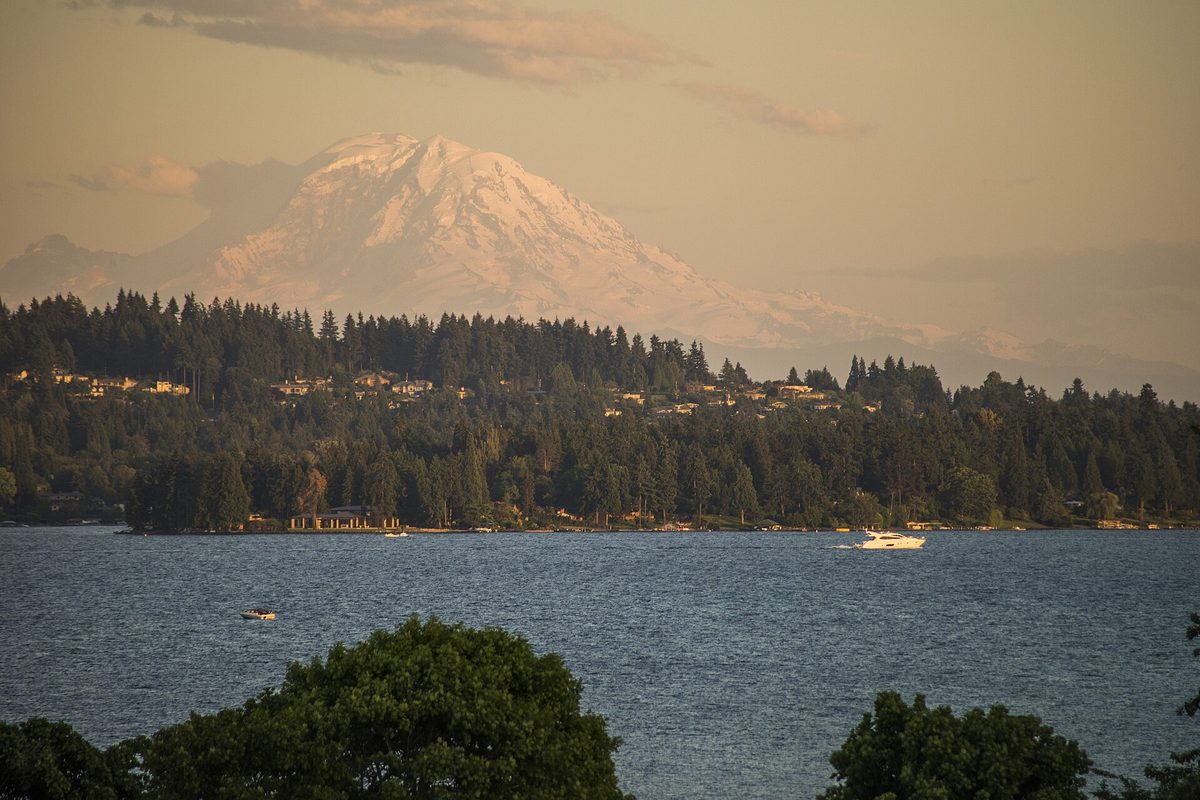
On the shore of Lake Washington, a dozen tall steel towers hold organ pipes up to the wind. Each pipe is attached to a weather vane, so it swings to face the breeze, and when the air moves through, it lets out a soft tone. The piece is Douglas Hollis's A Sound Garden, finished in 1983 for NOAA's Western Regional Center in northeast Seattle. A local band liked the name enough to borrow it.
Here's the part every visitor needs first. As of November 10, 2026, NOAA says its Western Regional Center campus and the Art Walk installations, Sound Garden included, remain closed to the general public until further notice, with no public access. So this guide gives you the story of the piece, the access rules in NOAA's own words, and a plan for the public park right next door, where you can spend a good windy afternoon.
Can you visit A Sound Garden right now?
Not as a member of the public. The NOAA Western Regional Center page states that the campus is closed to the general public, and that NOAA-sponsored visitors must be placed on the center's Non-Credentialed Access List by authorized staff in each program office. NOAA's national page for the center adds that escorts must be arranged in advance, visitors show a valid photo ID and their destination to a security officer, and bags may be searched or x-rayed.
This isn't new. Internet Archive copies of the NOAA page already read "Campus closed" in June 2020, and the current wording about the Art Walk and Sound Garden has been there since at least April 2023. NOAA posts no public hours and no reopening date. The only contact it lists for questions is WRC.Inquiries@noaa.gov. Please skip the gate on Sand Point Way. It's a secured federal site, and with no public access listed, walk-up visitors have no way in.
Arranged visits do happen. The University of Washington's German Studies department wrote up a faculty and student trip there in February 2025, and in the same post called the piece "infamously inaccessible." That about sums it up.
How a wind organ works
Billboard's 2017 description is the clearest: 12 steel towers, each 21 feet tall, with an organ pipe at the top of each that sounds a tone when the wind blows. The Seattle Parks brochure for the NOAA Art Walk calls them steel towers with wind-actuated organ pipes. Because each pipe rides a vane, it turns into the wind on its own. The wind is the player here, so the sound rises and fades with the weather.
The same brochure says that of the five sculptures on the Art Walk, A Sound Garden draws the most attention and has reached something like landmark status in Seattle. It says the piece got a boost after a Seattle band took its name, and credits the rest to the experience of standing under the vanes listening to what it calls the music of the earth.
The Art Walk on an old Navy airfield
The site has a layered past. Sand Point was a Naval Air Station for much of the 20th century. According to NOAA's history of the center, the land was split in the mid-1970s after a long public debate, with part going to NOAA for a regional center and the rest to the city for a park. A citizens' liaison committee reviewed designs for both.
The landscape plan included a public walk along the Lake Washington shore heading west from the park. The Seattle Arts Commission guided the jury, which picked artists from a pool of more than 250, and NOAA funded the work, with project help from the arts commission and the National Endowment for the Arts. The result, installed around 1983, is a small outdoor museum of early-'80s public art: Martin Puryear's Knoll for NOAA, Scott Burton's Viewpoint with chairs cut from boulders, Siah Armajani's two NOAA Bridges with lines from Moby-Dick set in them, George Trakas's Berth Haven, a cedar and steel deck on foundations left from the Navy airfield, and Hollis's towers.
Hollis, born in 1948 in Ann Arbor, built a career out of what the brochure calls giant aeolian instruments and singing bridges. In 1977 he set up Sound Site, a group of wind-played structures along the Niagara River. He also made a wind gate for the main entrance of San Francisco's Candlestick Park, and in 1997 won a federal Art-in-Architecture citation for Watersongs at a U.S. Geological Survey building in Menlo Park.
The band that took the name
NOAA's own history page says it plainly: the band Soundgarden took their name from this artwork. Few pieces of public art can say they named a famous rock band, and for years that drew music fans out to the lakeshore alongside the art crowd.
When singer Chris Cornell died in May 2017, fans turned the site into a memorial. Billboard reported that people arrived all day on May 18, 2017, leaving flowers and other tributes at the towers. That was back when the Art Walk was still open to visitors.
Spend the afternoon at Magnuson Park instead
Warren G. Magnuson Park sits right beside the NOAA campus, and it's fully public. Seattle Parks calls it the city's second-largest park, at 350 acres, with more than four miles of trails along a mile of Lake Washington shoreline. The grounds are open 4 a.m. to 11:30 p.m. The boat ramp, beach promenade and Kite Hill keep 6 a.m. to 10 p.m. hours, and lots E1 through E4 lock at 10 p.m.
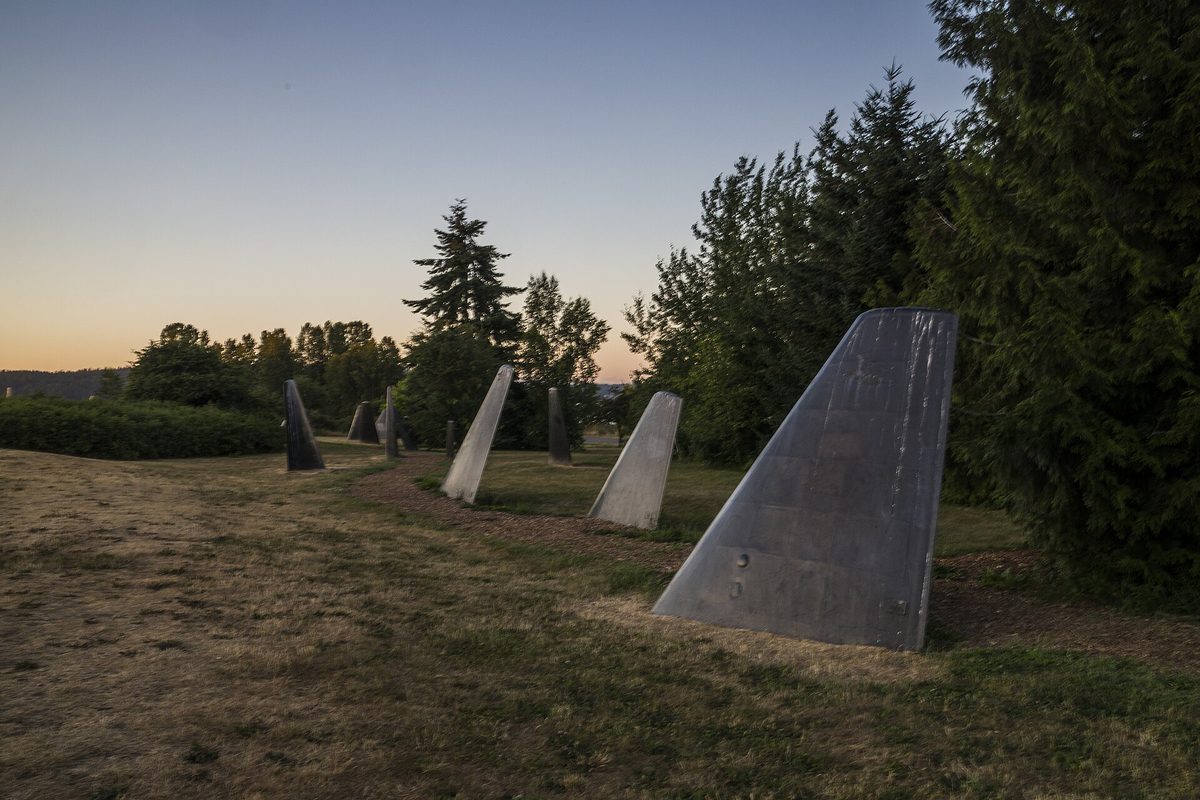
Start with the art. The Fin Project: From Swords into Plowshares, by University of Washington sculptor John T. Young, uses 22 diving-plane fins from decommissioned 1960s Navy attack submarines. The Seattle Times puts them at 4 to 12 feet tall, set among the trees near the lake. Up close they look like standing stones. From the top of Kite Hill they read the way Young meant them to, as a pod of orcas cutting through the ground. The piece was dedicated on Memorial Day, 1998.
Then climb Kite Hill itself. It's the wind-tossed mound the Seattle Times mentions, and on a breezy day it's a good place to feel the same lake wind that plays Hollis's pipes next door. Bring a kite if you have one.
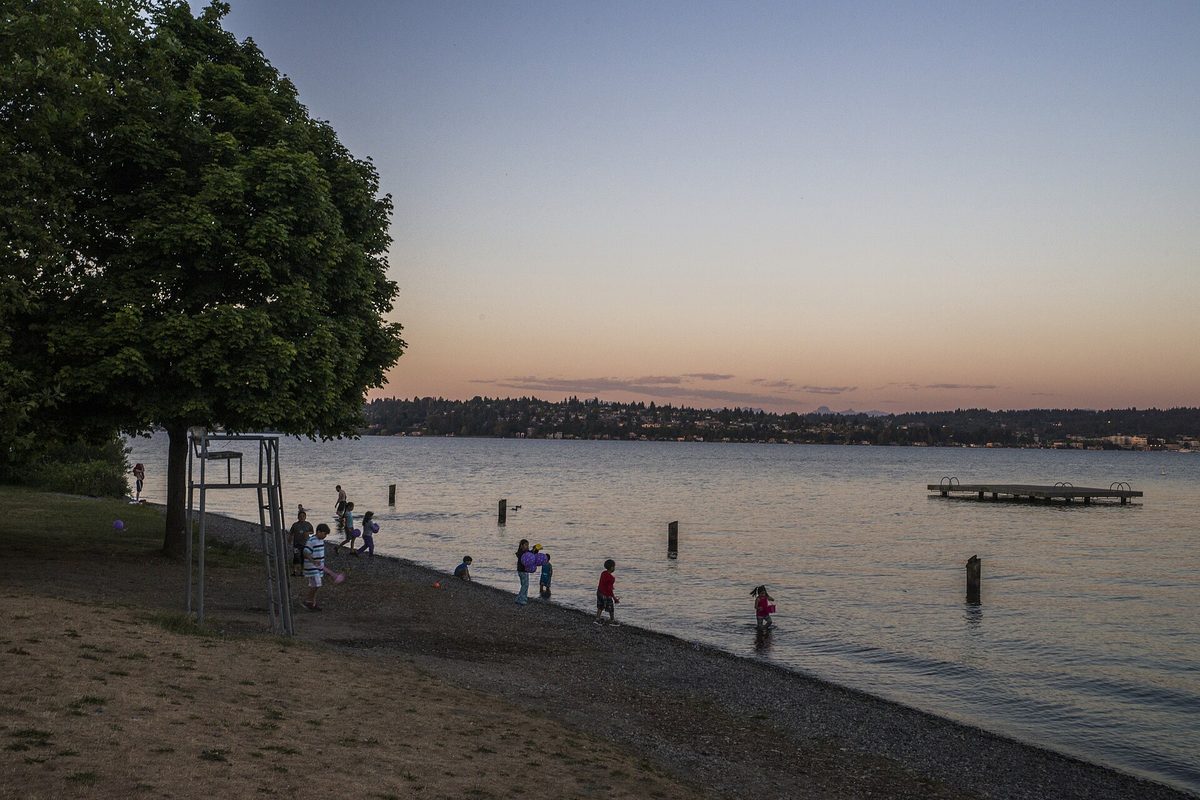
The park's history is worth a slow loop too. Seattle Parks notes that Sand Point, as the city's first municipal airport, was the launch site of the first around-the-world flight in 1924, three years before Charles Lindbergh landed the Spirit of St. Louis there. The Navy-era historic district has more than 20 brick and metal buildings from the 1930s and 1940s in Art Deco and Colonial Revival styles. Near Northeast 74th Street and 62nd Avenue Northeast, the Freedom Tree, a deodar cedar, was dedicated in 1972 to Washington's prisoners of war and missing in action.
Visit: Warren G. Magnuson Park, 7400 Sand Point Way NE, Seattle, WA 98115. seattle.gov/parks. (206) 684-4946. Free. The NOAA campus at 7600 Sand Point Way NE is a separate, secured site; enjoy the lake from the park's own shoreline.
Before you go
- Treat A Sound Garden as closed. NOAA lists no public access as of November 10, 2026. Check wrc.noaa.gov for changes, or write to WRC.Inquiries@noaa.gov.
- Plan the day around Magnuson Park. The Fin Project, Kite Hill and the shoreline trails are public and free.
- Pick a windy day. It's better for kites, and it's the weather the Sound Garden was built for.
- Watch the clock. Kite Hill and the beach promenade close at 10 p.m., and the E lots lock then too.
- Want to hear a singing structure in person? San Francisco's Wave Organ is free, public and played by the bay tides.
Sources
- NOAA Western Regional Center (campus and Art Walk closed to the general public; checked November 10, 2026): wrc.noaa.gov
- NOAA: NOAA Western Regional Center (visitor access and campus history): noaa.gov
- NOAA, "NOAA's Development of the Western Regional Center" (archived Sept. 22, 2017): web.archive.org
- Internet Archive captures of wrc.noaa.gov, June 23, 2020 and April 9, 2023: 2020, 2023
- Seattle Parks and Recreation: NOAA Western Service Center Art Walk brochure (archived 2013): web.archive.org
- Billboard, "Chris Cornell Memorial Erected at Seattle's Sound Garden Sculpture," Gil Kaufman, May 19, 2017: billboard.com
- University of Washington Department of German Studies, "Field Trip to NOAA Sound Garden," May 18, 2025: german.washington.edu
- Seattle Parks and Recreation: Magnuson Park (hours, size, contact) and Magnuson Park History: seattle.gov, seattle.gov
- The Seattle Times, "Magnuson Park's 'Fin Project' makes whales, not war, out of old weapons," Tantri Wija, April 8, 2024: seattletimes.com
- John T. Young: The Fin Project (artist's page): faculty.washington.edu
More Washington: Washington state guide · The most unique places in Washington · Twin Peaks filming locations · Washington geologic oddities · Washington's themed towns · Unusual Pacific Coast waterfalls · San Francisco's Wave Organ